
Back

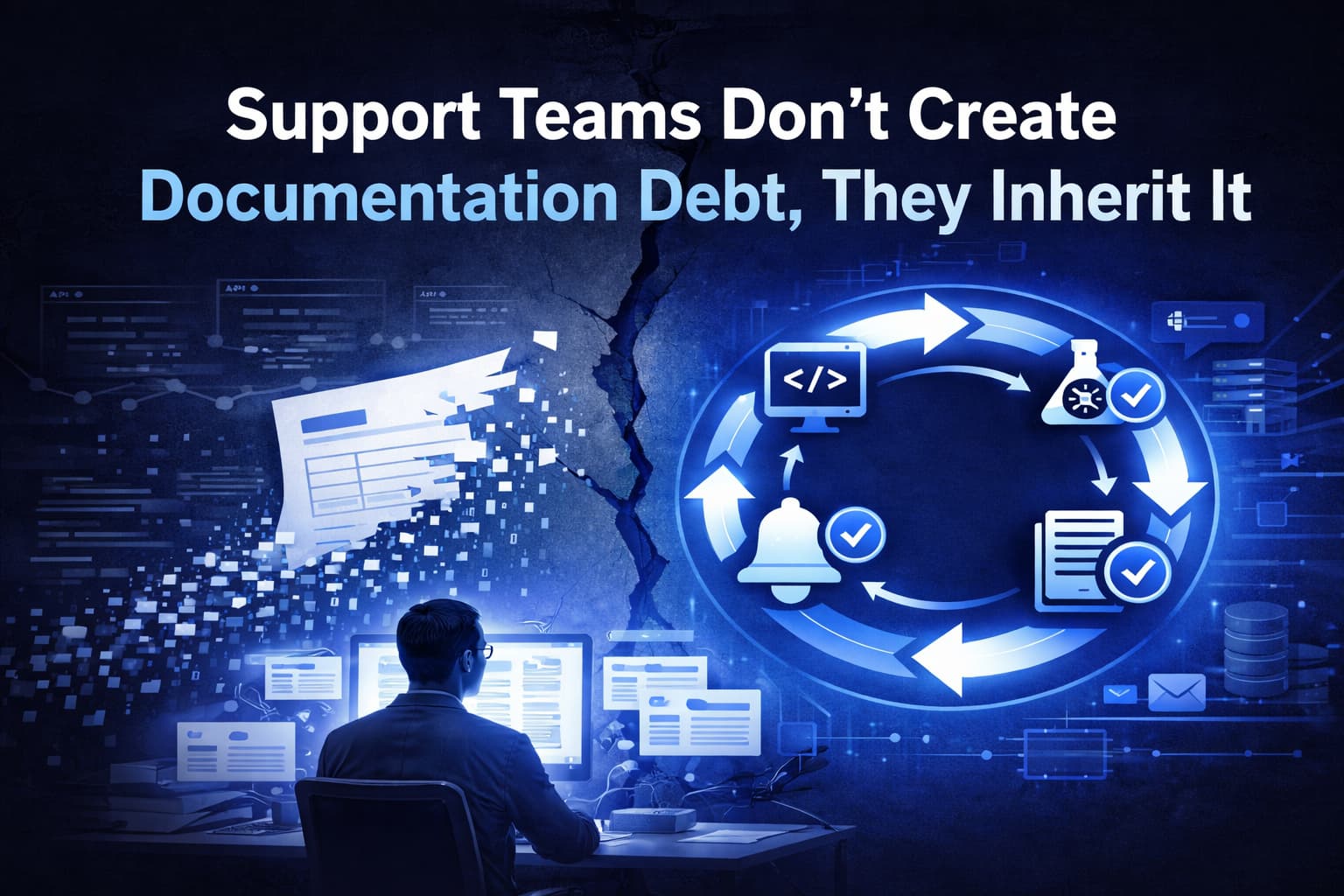
Support Teams Don’t Create Documentation Debt, They Inherit It

Support teams don't cause documentation drift—they pay for it with rising tickets, escalations, and engineer interruptions. Learn why it happens, its hidden costs in SaaS, and how to build a knowledge system that keeps docs aligned with product changes for lower support load.

In this article

This is some text inside of a div block.

Support Teams Don’t Create Documentation Debt, They Inherit It

Support teams are rarely the source of documentation problems.

But they are almost always the ones who pay for them.

When documentation drifts away from reality, it doesn’t fail in the repo.
It fails in the inbox.

  • Tickets increase.
  • Answers become inconsistent.
  • Escalations multiply.
  • Engineers get pulled back into conversations they thought they were done with.

From the outside, it looks like a support scaling problem.

It isn’t.

How Documentation Drift Shows Up in Support

Documentation drift doesn’t announce itself.

It shows up indirectly, through patterns support teams recognize immediately:

  • The same “how does this work?” ticket appears again and again
  • Agents give slightly different answers to the same question
  • Customers quote documentation that no longer matches product behavior
  • Escalations increase for issues that should be self-service
  • Senior support agents become the bottleneck for “tribal knowledge”

Support teams rarely describe this as a documentation issue.
They describe it as volume, complexity, or customer confusion.

But the root cause is almost always the same: The knowledge customers and agents rely on no longer reflects how the system actually behaves.

Why Support Feels This First

Engineering teams experience documentation drift slowly.
Support teams experience it immediately.

That’s because support operates at the boundary between:

  • How the product really works
  • What customers think it does

When those two diverge, support becomes the reconciliation layer.

Every undocumented change becomes:

  • A clarifying explanation
  • A workaround
  • A one-off answer typed manually
  • A Slack message to an engineer

Multiply that by hundreds of tickets per week, and documentation drift turns into operational load.

Not because support is inefficient, but because the system is leaking knowledge.

The Escalation Trap

Once documentation becomes unreliable, a predictable loop forms:

  1. Agents stop trusting the docs
  2. They rely on memory or senior teammates
  3. Answers become inconsistent
  4. Confidence drops
  5. Escalations rise
  6. Engineers get interrupted
  7. New undocumented knowledge is created… verbally

Nothing is fixed, the system just becomes louder.

Over time, support teams are not solving customer problems anymore, they are compensating for missing or incorrect knowledge.

Why “Better Docs” Rarely Fix Support Load

Many teams respond by:

  • Asking support to “update the docs”
  • Creating internal playbooks
  • Adding macros or canned responses
  • Introducing another documentation tool

These help locally, they don’t solve the underlying issue.

Because the problem isn’t that knowledge is missing, it’s that knowledge changes faster than humans can manually synchronize it.

Support teams don’t have the context to track every code change and engineering teams don’t see every support failure.

And documentation sits somewhere in between, disconnected from both. As long as that separation exists, support will keep inheriting the cost.

Documentation Drift Is a Cost Multiplier

What starts as “a few extra tickets” compounds quickly:

  • New support hires take longer to ramp
  • Senior agents become single points of failure
  • Customer trust erodes due to inconsistent answers
  • Engineers lose focus responding to avoidable escalations
  • Support costs rise faster than revenue

At scale, this shows up as:

  • Higher cost per ticket
  • Lower CSAT
  • Increased churn attributed to “poor support experience”

But the support team didn’t cause any of this, they are just downstream of a broken knowledge system.

The Real Issue: Knowledge Has No Owner in the System

In most SaaS teams:

  • Code is owned by engineering
  • Tickets are owned by support
  • Documentation is owned by… everyone and no one

When ownership is diffuse, correctness decays.

There’s no signal when:

  • A change should update an article
  • A resolved ticket should become reusable knowledge
  • A repeated question indicates missing documentation

Support feels the pain, but has no leverage to fix the source.

What Changes When Knowledge Becomes a System

The teams that escape this trap don’t ask support to work harder.

They change the structure.

They treat:

  • Code
  • Tickets
  • Documentation

as parts of the same system.

In these teams:

  • Product changes surface knowledge updates automatically
  • Repeated tickets become signals, not noise
  • Documentation reflects real behavior, not memory
  • Support answers are consistent because they’re grounded in truth
  • Escalations decrease without adding headcount

Support stops being a patch layer. It becomes a feedback signal.

Why This Matters Now

Modern SaaS teams ship faster than ever.
AI accelerates both answers and misinformation.
Customer expectations for self-service keep rising.

In this environment, documentation drift doesn’t just slow teams down.

It actively undermines trust.

Support teams are often blamed for that failure, but they are rarely the cause.

The Shift That Actually Works

The solution isn’t asking support to document more.

It’s ensuring knowledge stays aligned with the system as it evolves.

When documentation is treated as a byproduct of building and supporting software, not a manual task, support teams stop inheriting invisible debt.

This is the class of problems Knops exists to solve, not by replacing support or engineers, but by keeping knowledge grounded in reality as the product changes.

Final Thought

Support doesn’t scale when knowledge drifts.

The fastest way to reduce tickets is not answering more questions, it is ensuring fewer questions need to be asked in the first place.

That only happens when documentation stops being static and starts behaving like part of the system.

Documentation Doesn’t Fail Because Teams Don’t Write It

It Fails Because There Is No Feedback Loop

For most of the last decade, I have watched the same pattern repeat across engineering teams of all sizes.

Early on, documentation is “good enough.”
The codebase is small. Everyone knows where things live.
Questions are answered in Slack. Knowledge flows informally.

Then the system grows.

New engineers join. Support tickets increase.
Features ship faster than context can be shared.
And slowly, almost invisibly, documentation stops describing reality.

Not because people stopped caring, but because nothing in the system enforces correctness.

Why Documentation Decays Even in Well-Run Teams

Most teams understand that documentation is important. That is not the problem.

The real issue is that documentation is treated as a one-time artifact, while the system it describes is constantly changing.

Over time, several forces compound:

  • Engineers assume others can “read the code”
  • Managers assume documentation can be updated later
  • Senior developers carry architectural context in their heads
  • No shared agreement exists on what must be documented vs. what is obvious
  • Documentation work competes directly with shipping work

Even when teams invest in writing docs, they rarely invest in keeping them correct, and correctness is the hard part.

The Hidden Cost of Incorrect Documentation

Outdated documentation is worse than missing documentation, it creates false confidence.

Engineers follow instructions that no longer apply.
Support teams give answers that are technically incorrect.
New hires learn systems that don’t exist anymore.

Multiple studies show this isn’t a marginal problem:

  • Developers cite insufficient documentation as a leading cause of wasted time
  • Onboarding time for new engineers stretches into months
  • A significant portion of technical debt is documentation debt in disguise

Yet most teams measure documentation success by how much was written, not by how accurate it remains.

Documentation Has No Feedback Loop

Here’s the uncomfortable truth:

  • Code has tests.
  • Infrastructure has drift detection.
  • CI has policy gates.
  • Documentation, in most teams, has nothing.

There is no signal when documentation becomes incorrect.

  • A variable changes name.
  • An API flag is removed.
  • A service dependency shifts.

The system keeps working, but the documentation quietly diverges from reality.

  • No alert fires.
  • No pipeline fails.
  • No one notices until something breaks downstream.

This is not a discipline problem, it’s a systems design problem.

Why Writing Better Docs Doesn’t Solve This

Teams often respond by:

  • Adding more documentation
  • Hiring technical writers
  • Mandating documentation reviews
  • Introducing new documentation tools

These help with quality at the moment of writing. They do not solve continuous alignment.

The bottleneck is not producing documentation, but maintaining synchronization between source of truth and human explanation.

As long as documentation lives separately from the system it describes, drift is inevitable.

Where Automation Helps, and Where It Breaks

Recent AI tools have made it easier to:

  • Summarize code
  • Rewrite outdated sections
  • Restore missing context
  • Improve readability

This is valuable.

But AI alone struggles with:

  • Structural inconsistencies
  • Determining what is important vs. incidental
  • Detecting undocumented changes across systems
  • Acting as a deterministic validator of truth

AI can improve language but it cannot define truth without grounding.

Which brings us back to the core issue.

Documentation Is a Living Artifact, Not a Static Asset

The moment documentation stops being treated as part of the system, it starts lying.

The teams that avoid this trap don’t write more docs. They build knowledge systems with feedback loops.

Systems where:

  • Code changes trigger knowledge updates
  • Tickets surface missing explanations
  • Documentation is derived from actual behavior
  • Accuracy is continuously re-validated
  • Knowledge serves engineering, support, and GTM equally

In these teams, documentation isn’t a task, it’s an output of how the system operates.

Why This Matters More Than Ever

Modern SaaS teams ship faster than documentation can keep up manually.

  • Support volume scales before headcount can.
  • Customer expectations for self-service are rising.
  • AI assistants amplify both correct and incorrect information.

In this environment, knowledge drift becomes an operational risk. Not just a productivity issue, but a revenue one.

The Real Shift Teams Need to Make

The breakthrough isn’t better writing.

It’s this mental shift: Documentation must be validated the same way code is.

Once teams internalize that, the solution becomes obvious.

Knowledge needs:

  • A source of truth
  • Continuous synchronization
  • Feedback from real usage
  • Human oversight without manual burden

This is the problem Knops is built around, not as another documentation tool, but as a system that keeps knowledge aligned with reality as products evolve.

Conclusion

Documentation doesn’t fail because engineers are careless, it fails because systems grow without feedback loops.

The teams that scale aren’t the ones that document more, they are the ones that ensure their knowledge can never silently drift away from the truth.