
Support Teams Don’t Create Documentation Debt, They Inherit It
Support teams are rarely the source of documentation problems.
But they are almost always the ones who pay for them.
When documentation drifts away from reality, it doesn’t fail in the repo.
It fails in the inbox.
- Tickets increase.
- Answers become inconsistent.
- Escalations multiply.
- Engineers get pulled back into conversations they thought they were done with.
From the outside, it looks like a support scaling problem.
It isn’t.
How Documentation Drift Shows Up in Support
Documentation drift doesn’t announce itself.
It shows up indirectly, through patterns support teams recognize immediately:
- The same “how does this work?” ticket appears again and again
- Agents give slightly different answers to the same question
- Customers quote documentation that no longer matches product behavior
- Escalations increase for issues that should be self-service
- Senior support agents become the bottleneck for “tribal knowledge”
Support teams rarely describe this as a documentation issue.
They describe it as volume, complexity, or customer confusion.
But the root cause is almost always the same: The knowledge customers and agents rely on no longer reflects how the system actually behaves.
Why Support Feels This First
Engineering teams experience documentation drift slowly.
Support teams experience it immediately.
That’s because support operates at the boundary between:
- How the product really works
- What customers think it does
When those two diverge, support becomes the reconciliation layer.
Every undocumented change becomes:
- A clarifying explanation
- A workaround
- A one-off answer typed manually
- A Slack message to an engineer
Multiply that by hundreds of tickets per week, and documentation drift turns into operational load.
Not because support is inefficient, but because the system is leaking knowledge.
The Escalation Trap
Once documentation becomes unreliable, a predictable loop forms:
- Agents stop trusting the docs
- They rely on memory or senior teammates
- Answers become inconsistent
- Confidence drops
- Escalations rise
- Engineers get interrupted
- New undocumented knowledge is created… verbally
Nothing is fixed, the system just becomes louder.
Over time, support teams are not solving customer problems anymore, they are compensating for missing or incorrect knowledge.
Why “Better Docs” Rarely Fix Support Load
Many teams respond by:
- Asking support to “update the docs”
- Creating internal playbooks
- Adding macros or canned responses
- Introducing another documentation tool
These help locally, they don’t solve the underlying issue.
Because the problem isn’t that knowledge is missing, it’s that knowledge changes faster than humans can manually synchronize it.
Support teams don’t have the context to track every code change and engineering teams don’t see every support failure.
And documentation sits somewhere in between, disconnected from both. As long as that separation exists, support will keep inheriting the cost.
Documentation Drift Is a Cost Multiplier
What starts as “a few extra tickets” compounds quickly:
- New support hires take longer to ramp
- Senior agents become single points of failure
- Customer trust erodes due to inconsistent answers
- Engineers lose focus responding to avoidable escalations
- Support costs rise faster than revenue
At scale, this shows up as:
- Higher cost per ticket
- Lower CSAT
- Increased churn attributed to “poor support experience”
But the support team didn’t cause any of this, they are just downstream of a broken knowledge system.
The Real Issue: Knowledge Has No Owner in the System
In most SaaS teams:
- Code is owned by engineering
- Tickets are owned by support
- Documentation is owned by… everyone and no one
When ownership is diffuse, correctness decays.
There’s no signal when:
- A change should update an article
- A resolved ticket should become reusable knowledge
- A repeated question indicates missing documentation
Support feels the pain, but has no leverage to fix the source.
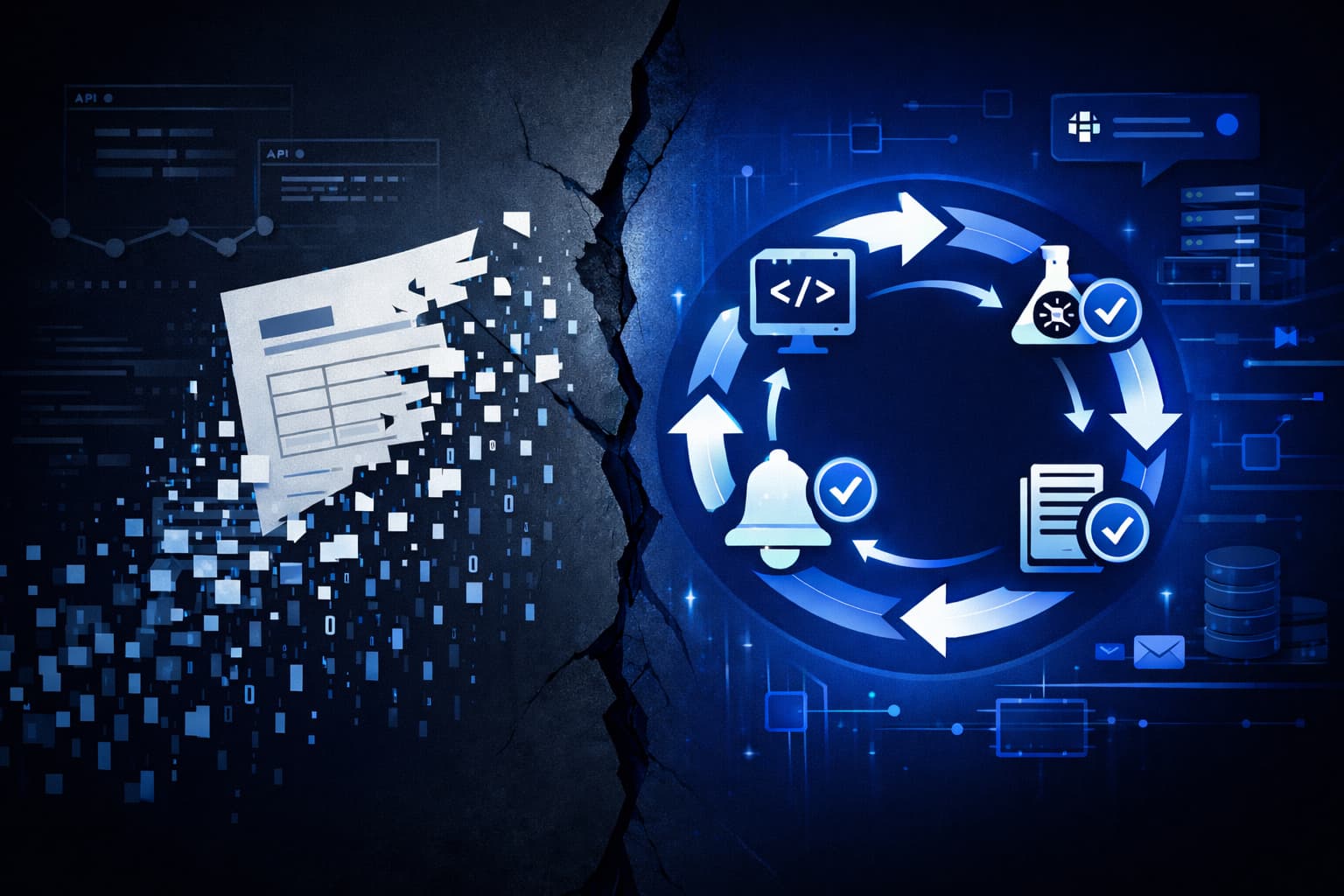
What Changes When Knowledge Becomes a System
The teams that escape this trap don’t ask support to work harder.
They change the structure.
They treat:
- Code
- Tickets
- Documentation
as parts of the same system.
In these teams:
- Product changes surface knowledge updates automatically
- Repeated tickets become signals, not noise
- Documentation reflects real behavior, not memory
- Support answers are consistent because they’re grounded in truth
- Escalations decrease without adding headcount
Support stops being a patch layer. It becomes a feedback signal.
Why This Matters Now
Modern SaaS teams ship faster than ever.
AI accelerates both answers and misinformation.
Customer expectations for self-service keep rising.
In this environment, documentation drift doesn’t just slow teams down.
It actively undermines trust.
Support teams are often blamed for that failure, but they are rarely the cause.
The Shift That Actually Works
The solution isn’t asking support to document more.
It’s ensuring knowledge stays aligned with the system as it evolves.
When documentation is treated as a byproduct of building and supporting software, not a manual task, support teams stop inheriting invisible debt.
This is the class of problems Knops exists to solve, not by replacing support or engineers, but by keeping knowledge grounded in reality as the product changes.
Final Thought
Support doesn’t scale when knowledge drifts.
The fastest way to reduce tickets is not answering more questions, it is ensuring fewer questions need to be asked in the first place.
That only happens when documentation stops being static and starts behaving like part of the system.